Borderline Personality Disorder
Borderline Personality Disorder is an illness that consists of various consist mood changes, self-image and behavior problems. This disorder causes individuals to think impulsively and creates a huge hurdle within relationships because of the actions that the individuals does. Individuals with this disorder are often plagued with intense emotions such as abandonment. According to Mayo Clinic, "Yet inappropriate anger, impulsiveness and frequent mood swings may push others away, even though you want to have loving and last relationships" (Mayo Clinic, 2019). Individuals with this disorder often have issues with maintaining healthy relationships because they often go through serious of mood swings that often leave their partners puzzled and may push them away. This disorder may be diagnosed in early adulthood, but may be discovered in early childhood with it progressing for the worse within them. Individuals with this disorder do have a chance of a normal life with proper treatment and management of the disorder.
Signs and Symptoms
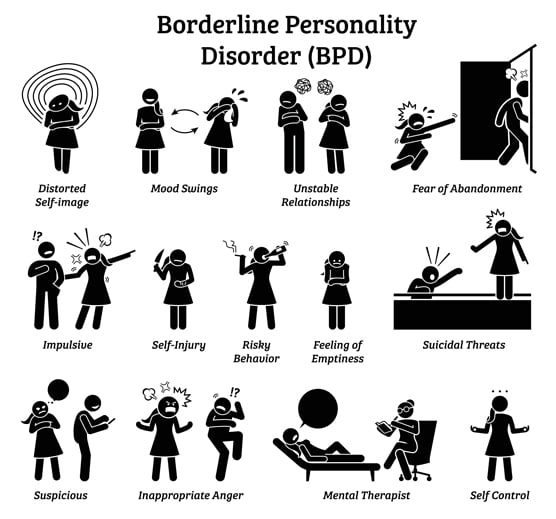
- Intense fear of abandonment, evening going to extreme measures to avoid real or imagine separation or rejection (Mayo Clinic, 2019).
- Having an ongoing pattern of unstable relationships by displaying a negative image of their partner and misbelieving their intentions.
- Various changes in self-identity and self-image; shifting of goals and values and idealizing your self in a negative life as if you are not there.
- Impulsive and risky behavior such as drunk driving, not practicing safe sex, spending sprees, binge eating and drug usage or sabotaging the self by ending a good job or a good relationship without no necessary cause
- Suicidal threats or self-injury due to fear of separation or rejection
- Widespread of mood swings lasting from hours to days including intensified emotions of the individual such as happiness, irritation, anxiety, etc.
- Feeling of emptiness over a long period of time
- Intense anger at inappropriate times
Borderline personality disorder. (2019, July 17). Retrieved November 08, 2020, from https://www.mayoclinic.org/diseases-conditions/borderline-personality-disorder/symptoms-causes/syc-20370237
Borderline Personality Disorder. (n.d.). Retrieved November 08, 2020, from https://www.nimh.nih.gov/health/topics/borderline-personality-disorder/index.shtml
Kristalyn Salters-Pedneault, P. (2020, January 21). Striking Statistics About Borderline Personality Disorder in the U.S. Retrieved November 08, 2020, from https://www.verywellmind.com/borderline-personality-disorder-statistics-425481
Picture: https://www.dummies.com/health/mental-health/borderline-personality-disorder-for-dummies-cheat-sheet/


That is so interesting about how more women are diagnosed with BPD than men. It is completely backwards to what I would have originally thought. It is an emotional disorder so I can see how women could just be placed under this umbrella to just get a diagnosis as well.
ReplyDeleteBut honestly, if you go back and read the symptoms you listed out, it almost sounds like what women are accused and stereotyped to be after a break up or poor relationship.
Your post was very interesting to read through, it makes sense why women would be more likely to be diagnosed with BPD, as women are often stereotyped to have it after a bad break up a poor relationship.
ReplyDelete